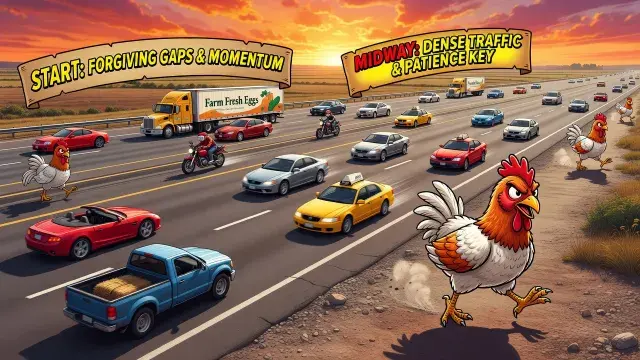
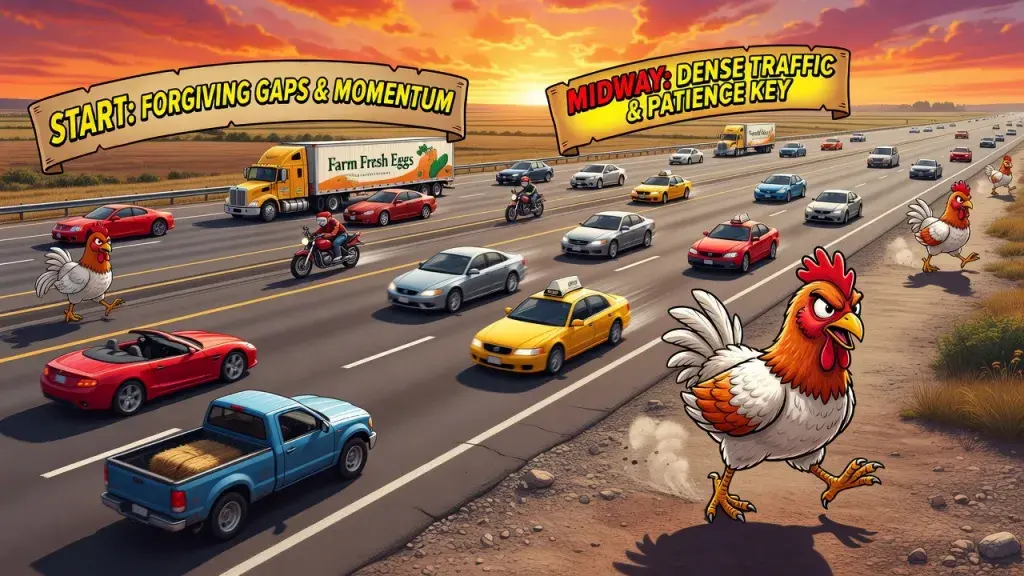
A chicken standing at the edge of a busy highway is not a punchline. It is a decision point, repeated dozens of times in rapid succession, each one carrying the weight of everything that came before it. That single image - feathers ruffled, traffic roaring past, a narrow window of safety opening and closing - is the entire premise behind one of the more addictive browser and mobile games to emerge in recent years. What looks like a simple animal-crossing gimmick turns out to be a tight test of timing, risk calculation, and nerve.
The mechanics are deceptively minimal: move forward, stop, wait, move again. Yet within that loop sits a genuine puzzle of probability and patience. Players who treat it casually lose fast. Players who study the pattern of oncoming traffic, learn to read the rhythm of the road, and commit to a real strategy tend to last far longer. For anyone starting out, working through a clear chicken road game step by step walkthrough saves hours of trial and error. From there, the real fun begins - building your own approach to the chicken-crossing game and figuring out what separates a lucky run from a repeatable one.
This guide breaks the whole experience down: how the game works, why it feels like a road trip adventure in miniature, and what a disciplined, step-by-step chicken journey actually looks like in practice.
Understanding the Chicken-Crossing Game at Its Core
What the Game Actually Simulates
Strip away the cartoon graphics and the chicken-crossing game is a probability simulator dressed up as entertainment. Each lane of traffic represents an independent risk event. The chicken must cross a sequence of these events without getting hit, and the reward scales with how many lanes have been cleared. This is not fundamentally different from other incremental-risk games, but the visual metaphor - a vulnerable bird against a wall of moving vehicles - makes the stakes feel immediate in a way that abstract numbers never do.
Why the Format Has Staying Power
Games built on escalating risk succeed when the tension is legible. Here, the player can see exactly what is coming: a truck, a gap, another truck. There's no hidden information, which means losses feel earned rather than random. That transparency is part of why the format keeps players returning - the outcome always traces back to a decision the player made, not an obscure mechanic they couldn't see.
The Core Loop in Plain Terms
- Assess the current lane before committing to movement
- Move only when the gap in traffic justifies the risk
- Bank progress at sensible intervals rather than pushing every single time
- Accept that a loss ends the run, so timing matters more than speed
Framing It as a Road Trip Adventure
The Journey Metaphor Behind the Mechanics
Calling this a road trip adventure is not just marketing flavor. The structure mirrors an actual overland journey: a starting point, a series of obstacles, brief rest stops, and a destination that keeps receding the closer you get to real mastery. Just as a physical road trip demands fuel stops and route planning, the game demands pacing - knowing when to pause and consolidate rather than charge straight through.
Pacing Yourself Like a Long-Distance Driver
Drivers on a genuine cross-country trip don't drive sixteen hours straight on the first day. They build up tolerance, learn their limits, and adjust based on conditions. The same logic applies here. Early sessions should be short and exploratory. Once the traffic patterns start to feel predictable, longer, more ambitious runs become viable.
Reading the Road Like Terrain
Every lane has its own personality - some move fast and thin out quickly, others stay dense with only brief slivers of opportunity. Learning to read this terrain, lane by lane, is what turns the chicken-crossing game from a guessing exercise into something closer to a skill.
The Step-by-Step Chicken Journey Explained
Stage One: Observation Before Movement
Before the chicken takes a single step, the smartest move is to simply watch. Traffic density at the start of a run often previews what's coming in later lanes. Spending a beat assessing speed and spacing costs nothing and prevents impulsive losses.
Stage Two: Committing to the First Few Lanes
The opening lanes are typically the most forgiving. This is where a step-by-step chicken journey should build momentum - cross confidently, but never carelessly. Establishing an early rhythm makes it easier to judge timing once the traffic thickens.
Stage Three: Managing the Mid-Journey Squeeze
Midway through most runs, gaps shrink and vehicle speed increases. This is the point where impatience causes the most losses. Waiting an extra beat here, even when it feels like wasted time, is almost always the better trade.
Stage Four: Deciding When to Stop Pushing
Every run eventually reaches a point where the potential reward no longer justifies the risk of the next lane. Recognizing that threshold - and walking away with what's already banked - is the difference between a sustainable strategy and a pattern of overreach.
Practical Strategies to Escape the Chicken Road
Timing Over Speed
The instinct to escape the chicken road quickly, darting through lanes as fast as possible, is usually a losing one. Speed without timing just accelerates the moment of failure. Precision in reading gaps consistently outperforms raw reaction speed.
Setting a Personal Stopping Point
Before starting a run, decide on a target - a number of lanes, a reward threshold - and hold to it. This removes the emotional decision-making that creeps in once momentum builds and the temptation to push "just one more lane" takes over.
Learning From Failed Runs
Every unsuccessful attempt carries information. Which lane caused the loss? Was it a misjudged gap or a moment of impatience? Reviewing failures honestly is more useful than replaying the same instinctive pattern repeatedly and expecting a different outcome.
Navigating the Chicken on the Road Challenge Under Pressure
Why Later Stages Feel Harder
The chicken on the road challenge intensifies as progress accumulates, both because traffic genuinely gets denser and because the psychological stakes rise. Losing after banking a large amount of progress stings more than losing early, and that emotional weight can distort judgment.
Keeping Composure at High Stakes
The players who last longest treat each lane individually, regardless of how much has already been won. Tunnel vision on the cumulative total, rather than the immediate gap in front of you, is a common cause of late-run mistakes.
Recognizing When Confidence Becomes Overreach
A string of successful crossings can create a false sense of control. Traffic doesn't get easier because you've gotten lucky - it stays exactly as unpredictable as it started. Treating each lane on its own merits keeps confidence from tipping into carelessness.
Building Long-Term Skill and Enjoying the Full Adventure
Turning Repetition Into Genuine Improvement
Repeated play only builds skill if each run is treated as a learning opportunity rather than pure entertainment. Noticing patterns in gap timing, vehicle speed, and personal decision-making under pressure compounds over time into noticeably better performance.
Balancing Risk-Taking With Consistency
The most successful long-term players aren't the boldest - they're the most consistent. A steady, repeatable approach to each run, refined gradually, outperforms an erratic style that swings between reckless pushes and overly cautious stalling.
Why the Adventure Never Really Gets Old
Because no two runs unfold identically, the sense of a road trip adventure never fully fades. Each session offers a fresh sequence of gaps and risks, which keeps the challenge engaging long after the basic mechanics have been mastered.
Questions?
Is there a guaranteed way to win every run of the chicken-crossing game?
No. The traffic patterns carry enough randomness that no strategy eliminates risk entirely. What a solid strategy does is reduce unnecessary losses caused by poor timing or impatience, which improves consistency over the long run rather than guaranteeing any single outcome.
How long does it typically take to get good at reading traffic gaps?
Most players notice a meaningful improvement after a few dozen focused runs, provided they're actually reviewing mistakes rather than repeating the same instinctive movements. Deliberate observation speeds this up considerably compared to casual, unreflective play.
Should I always aim to clear as many lanes as possible before stopping?
Not necessarily. Pushing for maximum lanes increases both potential reward and the chance of losing everything banked in that run. A predetermined stopping point, decided before the run begins, tends to produce more stable results over time.
What's the biggest mistake new players make?
Rushing. New players often try to cross as fast as possible, treating the game as a reaction-time test rather than a timing and observation exercise. Slowing down to actually read each lane before moving eliminates a large share of early losses.
Does the difficulty increase at a fixed rate, or does it vary?
Difficulty generally trends upward as a run progresses, with traffic becoming denser and faster in later lanes. The exact pacing can vary between sessions, which is part of why treating every lane as its own decision, rather than assuming a fixed pattern, works better.
Is this game more about luck or skill?
It's a mix, but skill plays a larger role than it first appears. While individual gaps involve an element of chance, the decisions around when to move, when to wait, and when to stop are entirely within the player's control and account for most of the difference between short-lived and long-lasting runs.