Two standard six-sided dice produce thirty-six possible outcomes, but only eleven distinct sums. That imbalance is the entire engine behind Lightning Dice, and most players never stop to calculate what it actually means for their bankroll. The number seven appears six times more often than a two or a twelve, yet the payout tables often suggest otherwise if you don't read them carefully.
This gap between perceived and actual odds is where a proper lightning dice build starts to matter. Betting on high-multiplier numbers because they "feel due" is a common trap, and it drains bankrolls faster than any other habit at the table. Before placing a single chip, it helps to study a structured lightning dice strategy that treats the game as a probability exercise rather than a guessing contest - understanding the distribution curve changes how you read every roll that follows.
What follows is a breakdown of how the numbers actually behave, which combinations reward patience, and how to build a session plan that survives contact with a losing streak. None of this requires luck to understand - just arithmetic and discipline.
Understanding the Core Mechanics of Lightning Dice
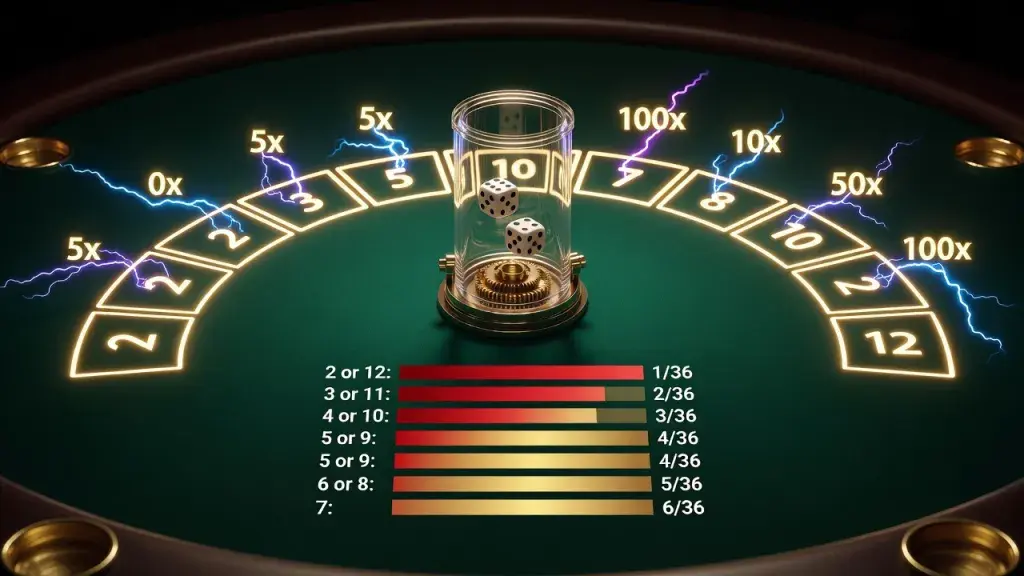
Lightning Dice is a live-style game built around two dice rolled inside a spinning cage, with random multiplier "strikes" applied to select numbers before each round. Players bet on which sum - from 2 through 12 - will appear, and the lightning multipliers can inflate a normally modest payout into something substantial. Grasping the mechanical skeleton of the game is the first step toward any lightning dice build worth following.
How the Dice and Multipliers Interact
Before the roll, the system randomly assigns multipliers - typically ranging from small boosts to triple-digit spikes - to one or more of the eleven number segments. These multipliers apply only to that round and reset afterward. A bet placed on a number that receives a multiplier pays out at the boosted rate; a bet on a number without one pays the standard fixed odds.
Standard Payouts vs. Multiplier Payouts
Each sum has a base payout tied inversely to its statistical frequency. Seven, being the most common outcome, pays the least under normal circumstances. Two and twelve, the rarest, pay the most. Multipliers override this base structure temporarily, which is why timing and number selection carry so much weight in any serious approach.
Why Mechanics Shape Strategy
Because multipliers are assigned before betting closes, players can adjust their wagers after seeing which numbers are "hot" for that round. This single mechanic separates Lightning Dice from static dice games and is the foundation for every combo-based approach discussed later.
Building a Lightning Dice Build That Works
A functional lightning dice build isn't a single bet pattern - it's a framework for deciding how much to wager, on which numbers, and when to walk away. Treating each round as an isolated event, rather than chasing patterns across rounds, is the mindset that separates sustainable play from impulsive play.
Bankroll Allocation for Multiplier Rounds
Reserve a fixed percentage of your session bankroll - many experienced players use 5 to 10 percent - for rounds where a multiplier lands on a low-probability number like 2 or 12. These rounds carry higher variance but also the highest reward ceiling.
Balancing Frequent Numbers with High-Value Numbers
A resilient build usually splits wagers between statistically frequent sums (6, 7, 8) for steady returns and less frequent sums (2, 3, 11, 12) when multipliers appear on them. This mirrors a barbell approach: safety on one end, upside on the other.
Adjusting the Build Based on Session Goals
A short, high-variance session calls for heavier weighting toward multiplier chasing. A longer session focused on preserving bankroll should lean into the statistically common numbers, accepting smaller but more consistent wins.
- Short session (under 30 minutes): prioritize multiplier-boosted rare numbers
- Medium session (30-90 minutes): split bets between mid-range and rare sums
- Extended session (90+ minutes): concentrate on 6, 7, and 8 for stability
Lightning Dice Combos That Maximize Value
Combos in this context don't mean guaranteed winning sequences - dice have no memory - but rather bet structures that balance risk and reward within a single round. Well-designed lightning dice combos exploit the moments when multipliers land on otherwise unattractive numbers.
The Core Numbers Combo
Placing simultaneous bets on 6, 7, and 8 covers roughly 44 percent of all possible dice outcomes. This combo won't produce large payouts, but it produces frequent small ones, which is useful for maintaining bankroll longevity between multiplier events.
The Edge Numbers Combo
Betting on 2 and 12 together targets the rarest outcomes. Individually each has roughly a 1-in-36 chance per roll, so this combo is speculative by design. It only becomes efficient when a lightning multiplier lands on one of these numbers, at which point the payout-to-risk ratio shifts dramatically in the player's favor.
The Balanced Spread Combo
This combo spreads smaller wagers across five or six numbers spanning both common and rare sums. It sacrifices some potential upside for a lower chance of a completely empty round, which suits players who dislike long stretches without any return.
Lightning Dice Best Rolls: What History Tells Us
While every roll is independent, examining the theoretical frequency of each sum reveals which numbers deserve attention and which are consistently overvalued by players chasing big multipliers.
The Statistical Hierarchy of Outcomes
Seven sits at the top with six of the thirty-six possible dice combinations. Six and eight follow with five combinations each. Numbers grow progressively rarer moving toward the extremes, with two and twelve each representing a single combination out of thirty-six.
Why "Best" Doesn't Always Mean "Most Frequent"
The lightning dice best rolls, in terms of expected value, aren't always the most probable ones. A multiplier landing on a low-frequency number can produce an expected value far above what a non-multiplied seven or six offers, even though seven and six occur more often across a full session.
Recognizing High-Value Moments
The best moments to increase a wager are when a substantial multiplier lands on a number with moderate probability - something like 5 or 9 - because the combination of decent frequency and inflated payout creates a rare sweet spot in the expected value calculation.
Lightning Dice Probability Odds Explained
Every serious player benefits from internalizing the actual math rather than relying on instinct. The lightning dice probability odds are fixed by the physical properties of two six-sided dice and don't change round to round, regardless of recent outcomes.
The Full Probability Distribution
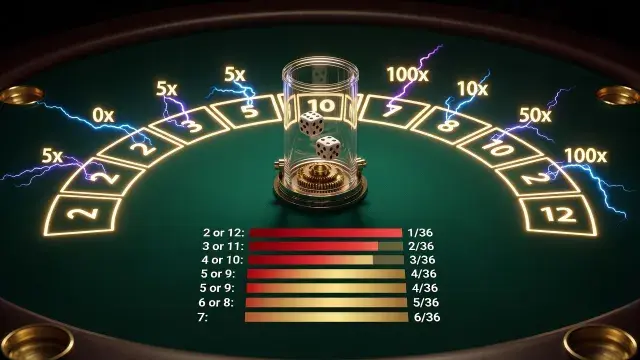
- 2 or 12: 1/36 (≈2.78%)
- 3 or 11: 2/36 (≈5.56%)
- 4 or 10: 3/36 (≈8.33%)
- 5 or 9: 4/36 (≈11.11%)
- 6 or 8: 5/36 (≈13.89%)
- 7: 6/36 (≈16.67%)
How Payout Tables Compensate for Probability
Operators structure fixed payouts inversely to these probabilities, so rarer numbers pay more to offset their lower hit rate. This is standard actuarial logic, not a flaw to exploit - the house edge remains embedded in the payout structure regardless of which number you favor.
Why the Gambler's Fallacy Fails Here
Believing a number is "due" after several rounds without appearing ignores the independence of each roll. The dice carry no memory of previous outcomes, and the probability odds reset completely with every throw.
A Practical Lightning Dice Strategy Guide
Combining the mechanics, the combos, and the probability data produces a workable session plan rather than a collection of isolated tips.
Pre-Session Preparation
Set a loss limit and a win target before the first bet. Decide in advance which combo structure - core numbers, edge numbers, or balanced spread - matches your risk tolerance for that session.
In-Session Decision Making
Watch for multiplier placement each round and adjust bet size only on numbers already within your chosen combo. Resist the urge to abandon your structure because a large multiplier appears on a number outside your plan.
Post-Session Review
Track which combos produced positive returns and which underperformed. Over multiple sessions, this record reveals whether your risk tolerance matches your actual results, allowing you to refine the build rather than repeat the same mistakes.
Frequently Asked Questions
Is there a way to predict where the lightning multipliers will land?
No. Multiplier placement is determined by a random process independent of previous rounds or dice outcomes. Any system claiming to predict multiplier placement is not describing an actual mechanic of the game.
Should I always bet on 7 since it's the most common outcome?
Betting on 7 provides frequent small wins because of its high probability, but its base payout is correspondingly low. A balanced approach that occasionally targets multiplier-boosted rare numbers typically yields better long-term expected value than betting on 7 exclusively.
How much of my bankroll should go toward high-multiplier bets?
Many experienced players cap multiplier-chasing bets at 5 to 10 percent of their total session bankroll per round. This limits downside exposure while still allowing participation when a favorable multiplier appears.
Can combos guarantee a profit over a session?
No combo guarantees profit, since the underlying probability odds and house edge remain constant regardless of bet structure. Combos manage risk and smooth variance, but they don't alter the mathematical expectation of the game.
What's the biggest mistake new players make with their lightning dice build?
Chasing losses by increasing bet size on rare numbers after a losing streak is the most common error. This approach ignores the independence of each roll and often accelerates bankroll depletion rather than recovering it.
Does the number of players at the table affect my odds?
No. Other players' bets don't influence the dice outcome or multiplier placement. Your probability odds remain identical whether you're playing alongside one other person or a full table.